
Actuators Explained: Types of Actuators & Their Uses in Boiler, Burner & HVAC Systems
May 27th 2026
Actuators Explained: Types of Actuators & Their Uses in Boiler, Burner & HVAC Systems
If you work with boilers, burners, or HVAC systems, you rely on actuators every day — they're the muscle behind automated control, opening dampers, positioning valves, and modulating airflow so equipment runs safely and efficiently. This guide explains what an actuator is, breaks down the main types of actuators, and shows where each one is used.
What Is an Actuator?
An actuator is a device that converts an energy source — electricity, compressed air, or hydraulic fluid — into controlled mechanical motion. In combustion and process control systems, that motion positions something physical: a damper blade, a fuel valve, or a linkage. The actuator receives a signal from a controller and moves the component to the commanded position.
Put simply: a controller makes the decision, and the actuator carries it out. Without actuators, every adjustment to airflow or fuel flow would have to be done by hand.
The Main Types of Actuators
1. Electric Actuators
Electric actuators use an electric motor and gear train to produce motion. They're clean, precise, and easy to wire, making them the most common choice in modern HVAC and combustion systems. They come in two control styles:
- On/Off (two-position): The actuator drives fully open or fully closed — nothing in between. Good for simple jobs like isolating a damper or opening a fuel valve.
- Modulating (proportional): The actuator stops at any point in its travel, following a control signal such as 4–20 mA or a 135-ohm proportional input — allowing fine-tuned control of airflow and fuel for better efficiency.
Common uses: combustion air dampers, fuel-air linkage on burners, HVAC zone dampers, and modulating valve control.

Honeywell M9184C1031 Modutrol IV Motor
24V proportional electric actuator — 150 lb-in torque, non-spring return. A workhorse for damper and valve modulation.
View Product & Pricing →2. Spring-Return (Fail-Safe) Actuators
A spring-return actuator includes an internal spring that drives it to a known safe position if power is lost. When equipment shuts down or a fault occurs, the actuator automatically returns to a fail-safe state — for example, closing a fuel valve or shutting a combustion air damper.
Non-spring-return actuators, by contrast, simply hold their last position on power loss. The choice depends on whether the application requires a guaranteed safe position during a power failure.
Common uses: safety shutoff applications, smoke and fire dampers, and any system where a defined fail position is required by code.
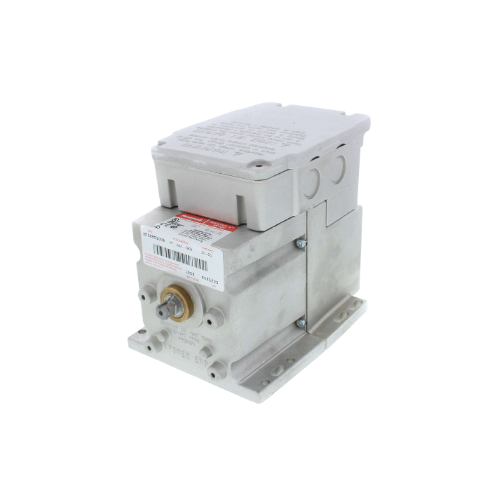
Honeywell M7285C1009 Modutrol IV Motor
120V spring-return actuator — 60 lb-in torque, 4–20 mA modulating. Returns to a safe position on power loss.
View Product & Pricing →3. Fluid Power Gas Valve Actuators
Fluid power actuators pair an electric component with a hydraulic mechanism to operate gas valves on commercial and industrial burners. They're engineered for smooth, controlled valve opening and fast, reliable closing — a critical safety feature in combustion systems.
Many include a proof-of-closure switch, which confirms to the burner control that the valve is fully seated before the system allows a restart, satisfying safety interlock requirements on commercial burner installations.
Common uses: gas valve operation on commercial and industrial burners, safety shutoff with interlock verification.

Honeywell V4055D1043 Gas Valve Actuator
120V on/off fluid power actuator with proof of closure — 13-second opening, fast safety closing for burner systems.
View Product & Pricing →4. Pneumatic Actuators
Pneumatic actuators use compressed air to generate motion. They're valued for being simple, durable, and fast-acting, and they perform well in older building automation systems and certain industrial process environments. Their main drawback is the need for a clean, dry compressed-air supply.
Common uses: legacy HVAC control systems, large industrial dampers, and process valve operation in plants with existing air infrastructure.
5. Hydraulic Actuators
Hydraulic actuators use pressurized fluid to produce very high force in a compact package. They're less common in standard HVAC and burner work but appear where heavy loads or large valves must be moved.
Common uses: heavy industrial process control and large-bore valve operation.
Damper Actuators vs. Valve Actuators
Beyond the power source, actuators are often described by what they move:
- Damper actuators rotate a shaft to open and close damper blades, controlling the flow of air — for example, combustion air to a burner or conditioned air through a duct.
- Valve actuators position a valve stem to control the flow of gas, water, or other fluids. On a burner, this means metering fuel; in hydronic systems, it means modulating hot or chilled water.
Many damper actuators mount directly to the damper shaft with a universal clamp, making installation and replacement straightforward. The Belimo AFB24-SR below is a good example of a direct-coupled, spring-return damper actuator.

Belimo AFB24-SR Damper Actuator
24V proportional, spring-return damper actuator — 180 lb-in torque, direct-coupled mounting for shafts up to 1.05".
View Product & Pricing →How to Choose the Right Actuator
When selecting a replacement or specifying a new actuator, key factors include:
- Voltage: commonly 24V or 120V — match your control system.
- Control signal: on/off versus modulating (4–20 mA, 135-ohm proportional, 0–10V, etc.).
- Torque: the actuator must have enough torque to move the damper or valve through its full travel.
- Fail-safe behavior: spring-return versus non-spring-return.
- Auxiliary switches: needed for interlocks, alarms, or position feedback.
- Mounting and stroke: make sure the physical fit and travel range match your equipment.
When in doubt, matching the original part number is the safest path — and cross-referencing an obsolete model to a current equivalent is something our team handles every day. Browse our full selection on the actuators category page, or explore actuators by brand: Honeywell and Belimo.
Frequently Asked Questions About Actuators
What does an actuator do?
An actuator converts electrical, pneumatic, or hydraulic energy into mechanical motion to position a damper, valve, or linkage in response to a controller's signal.
What is the difference between a spring-return and non-spring-return actuator?
A spring-return actuator drives to a known safe position when power is lost, while a non-spring-return actuator holds its last position. Spring-return models are used where a guaranteed fail-safe position is required.
What is the difference between a damper actuator and a valve actuator?
A damper actuator rotates a shaft to open and close damper blades to control airflow, while a valve actuator positions a valve stem to control the flow of gas, water, or other fluids.
How do I choose the right replacement actuator?
Match the voltage, control signal, torque rating, fail-safe behavior, auxiliary switches, and mounting style to your equipment. Matching the original part number is the most reliable approach — our team can also cross-reference obsolete models.
Need an Actuator? We Stock and Ship Them Fast.
Memphis Control Center is an authorized distributor for Honeywell, Belimo, Johnson Controls, Siemens, and 45+ more brands. We stock electric, spring-return, gas valve, and damper actuators — with same-day shipping on in-stock orders placed by 2 PM CT and free ground shipping on every online order.
Shop All Actuators Request a Quote
Can't find your part? Call us at 901-458-2000 — we cross-reference obsolete and discontinued actuators every day.