
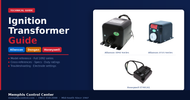
Ignition Transformer Selection Guide Allanson · Dongan · Honeywell ET401A1
Sep 8th 2026
The ignition transformer is one of the most frequently replaced components in a commercial or industrial boiler room. When a boiler won’t fire, the ignition transformer is often the first thing to check and replace. This guide covers the most common oil burner and gas burner ignition transformers stocked at Memphis Control Center — Allanson, Dongan, and the Honeywell ET401A1 — with specifications, burner cross-references, and field troubleshooting.
Memphis Control Center stocks Allanson, Dongan, and Honeywell ignition transformers for oil and gas burner applications across Tennessee, Arkansas, Mississippi, Alabama, and Louisiana. Same-day shipping on common models by 2 PM CT from Memphis. Call (901) 458-2000 with your burner make and model and we’ll confirm the right transformer.
An ignition transformer steps up low-voltage line power (typically 120V AC) to a high voltage — commonly 6,000V to 14,000V — that creates a high-energy spark across an electrode gap. This spark ignites the oil or gas fuel-air mixture at the burner.
The transformer consists of a primary winding (low-voltage input), a secondary winding (high-voltage output), and an iron core. The voltage ratio between primary and secondary windings determines the output voltage. The secondary output connects to the burner electrodes via high-voltage ignition cables.
Key specs to know when ordering: (1) Primary voltage — almost always 120V/60Hz for US commercial applications. (2) Secondary voltage — typically 6,000V, 8,500V, 10,000V, or 14,000V+ for electronic types. (3) Output current in milliamps (mA) — determines spark intensity. (4) VA rating — volt-ampere capacity. (5) Ground type — mid-point ground (most common for oil burners) or end ground. (6) Burner application — transformers are often designed to fit specific burner mounting configurations.
The spark jumps across the gap between two electrodes positioned in the fuel-air stream. Electrode gap and position vary by burner design — always verify the electrode setting matches the burner manufacturer’s specification when replacing a transformer. A transformer with too low an output voltage will not reliably bridge the electrode gap, especially at startup when the electrodes may be cold or slightly contaminated.
High voltage hazard: Ignition transformer secondary voltages — 6,000V to 14,000V — are potentially lethal. Always de-energize the burner control circuit before working on ignition components. Never touch ignition cables, electrode assemblies, or transformer output terminals with power applied.
There are two fundamentally different types of ignition transformers in commercial and industrial burner service, and they are not interchangeable without verifying compatibility with your burner control system.
| Characteristic | Conventional (Ferromagnetic) | Solid-State (Electronic Ignitor) |
|---|---|---|
| Operating principle | Iron-core transformer, 60 Hz AC output | High-frequency inverter, typically 20–25 kHz output |
| Secondary voltage | 6,000–10,000V RMS (typical) | 14,000–17,500V peak (typical) |
| Spark frequency | 60 Hz (120 sparks/min) | 20,000+ Hz (millions of sparks/min) |
| Current draw | Higher (typically 0.5–1.5A at 120V) | Much lower (typically 0.15–0.3A at 120V) |
| Weight / size | Heavier — iron core | Lighter, more compact |
| Ignition cable type | Standard ignition cable with 7mm or push-on terminal | Specific high-frequency cable required |
| BMS compatibility | Works with any burner control with an ignition output | Must verify frequency compatibility with BMS |
| Examples (Allanson) | 2721-628G, 2721-620, 1092-F, 421 series | 2275-628G, 2275-U (OMNI) |
| Examples (Dongan) | A06-SA6, A08-SA1, A10-LA2, XD-BK103 | SS1-BK103, SSI series |
| Examples (Honeywell) | Q179 series | ET401A1 |
Do not substitute a solid-state ignitor for a conventional transformer without verifying compatibility. Solid-state ignitors produce high-frequency output that can interfere with some older flame detection systems (UV scanners, photocells). Always consult the burner manufacturer’s documentation before substituting ignitor types.
Allanson International is a Canadian manufacturer of ignition transformers and solid-state ignitors for commercial and industrial burner applications. Allanson transformers are designed to burner manufacturer specifications, built with high-temperature wire, double porcelain bushings, and meet American and European EMI/RFI noise emission standards. Their ferromagnetic "Small Can" series (model 2721) and solid-state series (model 2275) are the most widely stocked for Mid-South commercial and industrial boiler room applications.
Oil Burner Ignition Transformer · Beckett A, AF, AFG
The single most common ignition transformer in Mid-South commercial boiler rooms. Designed specifically for Beckett A, AF, and AFG oil burners — the dominant residential and light commercial oil burner platform. The “G” suffix indicates a replacement gasket is included; the 2721-628G is the current production version of the older 2721-628A.
Electronic Oil Ignitor · Beckett AFG, AF, A
Solid-state electronic ignitor version for the same Beckett A, AF, AFG platform. Higher peak voltage (17,500V vs 10,000V) produces a hotter, more reliable spark. Significantly lighter and lower current draw than the conventional 2721-628G. Not a direct drop-in — verify cable and mounting compatibility before substituting.
Oil Burner Ignition Transformer · Wayne E
The standard ignition transformer for Wayne E series oil burners — one of the most common oil burner platforms in light commercial and residential service alongside Beckett. Available from multiple distributors and widely stocked in the Mid-South market.
Universal Electronic Oil Ignitor
The OMNI Universal Electronic Oil Ignitor is designed to replace a wide range of conventional ferromagnetic oil burner transformers on Beckett, Wayne, Carlin, and other major oil burner platforms using included mounting plates and contact terminals. Useful as a single stocking item that covers many applications — the 2275-KIT1 service kit includes two OMNI ignitors with a selection of mounting plates and terminals.
Oil Burner Ignition Transformer · Beckett AFII
Designed specifically for the Beckett AFII burner — the updated Beckett platform. High-voltage cables with 1/4" push-on connectors and side bracket mounting distinguish this model from the standard 2721-628G. Important: the AFII uses a different mounting configuration than the older AF/AFG — confirm your burner model before ordering.
Universal Oil Burner Ignition Transformer
Universal replacement transformer designed for a broad range of oil burner applications where a specific replacement is unavailable. The 421 series provides a flexible mounting system that adapts to many burner configurations. Cross-references to France LAUV, Webster 312-25AX0600, Dongan LJH-90, Sid Harvey T1-15.
The 2721-628G “G” suffix: The “G” in 2721-628G indicates that a replacement gasket is included with the transformer. The 2721-628G is the current production replacement for the older 2721-628A (discontinued). The specifications are otherwise identical.
The 1092 series is Allanson’s single-pole ferromagnetic industrial gas ignition transformer line. All 1092 models are constant duty rated — designed to stay energized continuously during burner operation, which is what most industrial gas burner applications require. The suffix letter identifies the burner OEM application and mounting configuration.
| Model | Burner OEM / Application | Replaces (OEM Part Numbers) | Order |
|---|---|---|---|
| 1092-F | Universal / general industrial gas — BX cable connector | — | Shop → |
| 1092-H | Cleaver Brooks industrial gas burners | 612-8A021, 612-8A038V, 832-107 | Shop → |
| 1092-K | Dunham-Bush, Iron Fireman | 612-8AB017, 612-8AB051, 612-8AB0202 | Shop → |
| 1092-N | Ray Burner | — | Shop → |
| 1092-NA | North American | 612-8A02 | Shop → |
| 1092-PF-G | Power Flame (with ground wire) | 612-6A056, PFA-06 | Shop → |
| 1092-S | Gordon-Piatt | 612-6A020, 612-6A0202, 612-6A044, 612-6A072 | Shop → |
| 1092-SG | Webster — primary ground, 3-wire | 1092-SGSF | Shop → |
| Specification | Value |
|---|---|
| Input supply voltage | 120V |
| Input supply frequency | 50/60 Hz |
| Primary VA | 250 VA (60 Hz) / 180 VA (50 Hz) |
| Secondary voltage (RMS) | 6,000V |
| Secondary short-circuit current | 25 mA (60 Hz) / 20 mA (50 Hz) |
| Duty rating | Constant duty |
| Pole configuration | Single pole (end ground) |
| Operating temperature | −30°C to +40°C (−22°F to +104°F) |
| Storage temperature | −40°C to +80°C (−40°F to +176°F) |
| Operating relative humidity | 90% |
| Loading air gap | 1/16″ to 1/8″ |
Why the 1092 series matters for industrial gas applications: Unlike oil burner transformers (which typically energize only during trial-for-ignition), industrial gas burners often require the ignition transformer to remain energized continuously or for extended periods. The 1092 series is constant-duty rated for exactly this service. Using an intermittent-duty transformer in a constant-duty gas application will overheat and fail the transformer prematurely.
Suffix meanings on Allanson part numbers: “-G” generally indicates an included accessory — on the 2721-628G it means a replacement gasket is included; on the 1092-PF-G it means a ground wire is included. Always confirm exactly what the suffix means for the specific model you are ordering.
Memphis Control Center stocks common ignition transformers for same-day shipping by 2 PM CT from Memphis. Tell us your burner make and model and we’ll confirm the right transformer.
Dongan Electric Manufacturing Company has produced transformers since 1909. Founded in Albany, New York as the Dongan Electric Instrument Company and relocated to Detroit, Michigan in 1911, Dongan has manufactured ignition transformers for oil and gas burner applications for decades. Dongan transformers are known for rugged industrial construction and are widely specified for commercial and industrial gas burner applications. Dongan produces both conventional iron-core ferromagnetic transformers and solid-state ignitors (SSI series) covering the full range of oil and gas ignition needs.
Industrial Gas Ignition Transformer · 6,000V · Enclosed
Dongan’s most widely stocked industrial gas ignition transformer. Fully enclosed NEMA 1 construction for industrial environments. 100% duty cycle rated for continuous operation. Designed for oil and gas furnace and burner ignition systems. The A06-SA6 is a standard industrial cross-reference for a wide range of gas burner OEM transformer specifications.
Universal Gas Ignition Transformer · 8,500V · End Ground
Universal gas ignition transformer at 8,500V secondary — higher output voltage than the A06-SA6 for applications requiring a higher-energy spark. Suitable for gas pilot and main gas burner applications. The higher secondary voltage provides better ignition reliability across a wider range of electrode gap conditions.
Industrial Oil & Gas Ignition Transformer · 10,000V
Dongan’s industrial-grade 10,000V ignition transformer for oil and gas burner applications requiring higher secondary voltage. The LA2 designation indicates a specific terminal and mounting configuration in Dongan’s ignition transformer series. The A10 series covers the highest-voltage standard ignition transformer applications.
Oil Burner Transformer · Beckett A, AF, AFG Cross-Reference
The Dongan cross-reference for the Beckett A, AF, AFG platform — equivalent to the Allanson 2721-628G. Important for facilities and contractors who prefer Dongan or who need a cross-reference when the Allanson version is out of stock. Verify physical mounting dimensions match your burner before substituting.
Solid-State Ignitors · 14,000V · Oil Burner
Dongan’s solid-state ignitor (SSI) series provides a hot 14,000V arc with cool operating temperatures and long life dependability for fuel oil ignition applications. Like all solid-state ignitors, the SSI series is not a direct drop-in for conventional ferromagnetic transformers — cable type and BMS compatibility must be verified. The SS1-BK103 is the SSI cross-reference for Beckett burners (crosses to Allanson 2275-628G).
Oil Burner Transformer · Wayne E Cross-Reference
Dongan cross-reference for Wayne E oil burners — equivalent to the Allanson 2721-620. Wayne oil burners are commonly found on commercial boilers throughout the Mid-South alongside Beckett platforms.
The Honeywell ET401A1 belongs to a different category than the Allanson and Dongan transformers above. It is a compact electronic ignitor built specifically for interrupted gas pilot service — not a general-purpose replacement for a conventional ferromagnetic transformer. It is commonly found on packaged commercial and industrial gas burner systems where the burner control energizes the ignitor only during the trial-for-ignition period, then de-energizes it once main flame is proven.
When to specify the ET401A1 instead of an Allanson or Dongan transformer: Choose the ET401A1 when you have an interrupted gas pilot, need to mount the ignitor under the burner control box, need very low EMI (particularly with UV flame detection), or are replacing an existing ET401A1. Choose a conventional Allanson 1092 series or Dongan A06/A08 transformer when the application requires constant duty operation, when the transformer stays energized during burner run, or when you are matching an existing conventional transformer installation. The ET401A1’s 33% duty cycle rating makes it unsuitable for constant-duty gas pilot service.
Electronic Ignition Transformer · Gas Pilots & Gas Burners
The ET401A1 combines low power consumption with a low inrush current and very low electromagnetic interference — described by Honeywell as generating the lowest EMI of all known electronic ignitors. The compact housing (2 57/64” H × 3 15/16” W × 1 41/64” D / 73.5 mm × 100 mm × 41.5 mm) is dimensioned specifically to allow mounting underneath a burner control box.
Note: The ET401A1 is a single-pole (unipolar) design. Verify that your gas pilot electrode configuration is compatible with a unipolar ignitor — unipolar designs use one hot electrode and the burner body as ground. The ET402 is the bipolar version for applications requiring two hot electrodes.
Common cross-references between Allanson, Dongan, France, and Webster for the most popular oil burner applications. Use this table to find an equivalent when your standard brand is unavailable.
| Burner Application | Allanson | Dongan | France | Webster | Sid Harvey |
|---|---|---|---|---|---|
| Beckett A, AF, AFG (conventional) | 2721-628G | XD-BK103 | 5LAY-04 | 313-28AB-BAF | T-92 |
| Beckett A, AF, AFG (solid state) | 2275-628G | SS1-BK103 | 10SAY-04 | — | T92E(1) |
| Beckett AFII | 2741-658 | — | — | 3-32AB-BAF | — |
| Beckett S | 2721-605 | XD-BK204 | 5LAY-05 | 313-28AB92 | T-90 |
| Wayne E | 2721-620 | XD-WN208 | 5LAY-30 | 313-25AB78 | T-88 |
| Carlin 100 CRD | 2721-630 | — | — | — | — |
| Cleaver Brooks (gas) | 1092-H | A06-SJ5 | — | — | — |
| North American (gas) | 1092-NA | A06-SI1 | — | — | — |
| Universal (gas, 6kV) | 1092-F | A06-SA6 | 6EEGW-1 | — | T-146N |
| Universal (gas, 8.5kV) | — | A08-SA1 | 85EY-2 | — | — |
| Universal (gas, 10kV) | — | A10-LA2 | — | — | — |
| Universal oil burner | 421-BT-636 | LJH-90 | LAUV | 312-25AX0600 | T1-15 |
| Gas pilots (electronic) | — | — | — | — | Honeywell ET401A1 |
Always verify before substituting. Cross-references indicate equivalent electrical specifications, but mounting hole patterns, cable lengths, and connector types may differ between brands. When replacing an ignition transformer, compare the physical dimensions and connector type of the replacement against the original if possible. Call Memphis Control Center at (901) 458-2000 and we’ll help confirm the right match.
Browse our full in-stock inventory of Allanson, Dongan, and Honeywell ignition transformers and ignition controls. Orders placed by 2 PM CT ship same day from Memphis.
The most common field problems with ignition transformers and the ignition system overall. Before replacing a transformer, verify the electrodes and ignition cables are also in good condition — a failed transformer is often the symptom of a larger ignition system issue.
Diagnose first: A no-spark condition can be the transformer, the ignition cable, the electrode, or the burner control not energizing the ignition circuit at all. Check the burner control sequence first — is the ignition output being energized during the trial-for-ignition period? If yes, use an ignition tester or carefully hold the cable end near a grounded surface (with power on, at safe distance) to check for spark output from the transformer. If no spark: replace the transformer. If spark is present from the transformer but the electrode is not firing, check the cable condition and electrode gap and position. Carbonized or cracked electrodes and deteriorated ignition cables are as common as transformer failures.
Most likely cause: Weakening transformer output, deteriorated ignition cable (insulation breakdown), fouled electrode tip (carbon or oil contamination), or electrode gap out of specification. A transformer that tests good cold may break down at operating temperature — thermal degradation of the internal winding insulation. Check and clean the electrode tips first (a clean electrode with correct gap requires less voltage to fire). Inspect the ignition cable for cracks, hardening, or carbon tracking on the insulation. If the cable and electrode check out, replace the transformer.
Field test: The simplest test is a spark test — with the transformer installed and the burner control energizing the ignition output, use an ignition tester or carefully observe for spark at the electrode. If you have a DMM with an AC voltage range and a high-voltage probe, you can measure secondary output directly. Many technicians prefer a simple swap test: install a known-good transformer and see if the ignition problem resolves. Do not attempt to test an open transformer secondary with a standard DMM — the high voltage will damage the instrument. Ohmmeter testing of the secondary winding can confirm an open winding (infinite resistance) but a winding that tests in-range may still have breakdown insulation that fails under load.
Most likely cause: Continuous-duty operation of an intermittent-rated transformer, shorted secondary (electrode or cable short to ground), or winding failure. Conventional oil burner transformers in standard service are typically intermittent-rated — they are designed to energize only during the trial-for-ignition period and should de-energize once flame is established. A burner control malfunction that leaves the ignition transformer energized continuously will overheat and eventually fail an intermittent-rated transformer. Gas ignition applications often require continuous (constant) duty-rated transformers — verify your transformer is rated for continuous duty if the application requires it.
Check first: Ignition cables have a service life and deteriorate from heat, vibration, and repeated thermal cycling. Cracked, stiff, or oil-contaminated cable insulation allows high voltage to track to ground before reaching the electrode. Replace ignition cables whenever replacing the transformer — a new transformer connected to deteriorated cable will often fail prematurely as the cable arcing puts excess load on the transformer. Use the correct cable type for your transformer (conventional 7mm cable for ferromagnetic transformers; specific high-frequency cable for solid-state ignitors).
Reference: Incorrect electrode gap is a very common cause of ignition problems that gets misdiagnosed as a transformer failure. Always check the electrode gap against the burner manufacturer’s specification. For standard Beckett AFG (F, L, V heads), AF (F head), and AFII (FBX head) burners, Beckett specifies: 5/32” gap between electrode tips, 5/16” above the nozzle centerline, and 1/16” ahead of the nozzle face. For Beckett AFII (HLX, AF2 heads) and NX burners: 5/32” gap, 1/4” above centerline, 3/32” forward. Beckett’s T501 multipurpose gauge sets these dimensions accurately. For the Honeywell ET401A1: electrode gap should be 0.12 to 0.20 inches (3 to 5 mm). A correctly set electrode with a good cable requires less transformer output voltage to fire reliably than a worn electrode with a wide gap.
Memphis Control Center stocks Allanson, Dongan, and Honeywell ignition transformers for oil and gas burner applications across Tennessee, Arkansas, Mississippi, Alabama, and Louisiana. Same-day shipping on common models by 2 PM CT from Memphis. Tell us your burner make and model.
For emergencies, outside of business hours, call #901-604-7069